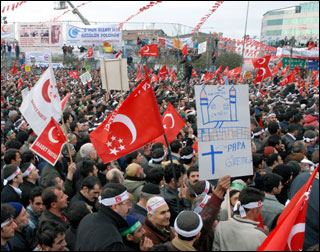
Necmettin Erbakan, former Turkish prime minister, leader of the "national outlook" branch of politics and convicted money launderer, died of heart failure today at Ankara's Güven hospital. He was 84, and had been in poor health for a number of years. He served just under a year as prime minister before being forced to resign in the "post-modern" coup of 1997, but his impact on the political scene was far longer than the time he spent at the top.
There are two things he will be remembered for: the political ideology he founded, and the manner of his departure as prime minister. He ought really to be remembered for a third - embezzlement of party funds - but probably won't be.
His political ideology, founded in 1969, was based partly on anti-Western values and the principle of economic self-sufficiency for Turkey. It was named
Milli Görüş ("national outlook"), a confusing name seeing as it advocated Turkish independence in the context of political Islam. It was this that attracted such a broad spectrum to Erbakan's following, from the observant villager to the pious cleric.
That said, his movement was not immediately successful, and the Turkish people elected him prime minister only after they had tried everyone else. His National Salvation Party hopped between left and right-wing governments as a junior coalition partner throughout the 1970s, and he was one of the four main party leaders arrested and banned from politics by the army after the 1980 coup, but it wasn't until 1991 that his party won more than 15 percent of the vote and he moved from the fringe to the centre stage.
The Nineties were a fractious time in Turkish politics, with inconlusive elections and unstable coalitions. Part of the problem was a derth of political talent: the generation that should have emerged during the Eighties had been stifled by the generals. That meant that those leading politicians of the left and right, Bülent Ecevit and Süleyman Demirel, came back to ply their trade just as they had done before the coup unseated them.
But everything in Turkey had changed since they were last in power, and politics had descended into a brawl. Mr Demirel's traditional centre-right voting base was occupied by a rival party concerned mostly with distinguishing itself from him. Ecevit faced a similar opponent. And this at a time when private television was showing new programmes and new ideas, the free market economy was bringing greater choice and competition (but plenty of opportunities for shady deals), and Kurdish separatism was on a crescendo. In all this hysteria, Erbakan preached stability, a return to religious values and, most importantly of all, something new.
It worked. To the alarm of the secular elite, he topped the December 1995 general election with more than 6 million votes, a 21 percent share. It was far from enough to govern alone, however, and the centre-right parties concluded a shabby truce to keep him out of power. It wasn't to last, however, and by June 1996 Necmettin Erbakan became prime minister and Turkey's most powerful Islamist since the last sultan. He was backed up by one of those bickering centre-right parties, True Path (DYP) under Tansu Çiller, on the understanding that the top job would be rotated to her after two years.
Erbakan's premiership was everything the secularists feared it would be. Turkey turned definitively east: after brokering an oil pipeline deal with Iran, he made a much publicised visit to Libya, where he signed an agreement of friendship with Muammar Gadafi, and branded the United States and Israel "agents of terror" in the process. At home, in scenes that have never been replicated under today's AK government, Erbakan's Welfare Party (RP) organised rallies in towns after Friday prayers which descended into demonstrations calling for sharia law.
The army's patience wore thin. On 4 February 1997, it sent 20 tanks through the high street in Ankara's Sincan suburb, where a number of pious RP festivals had been held, in a barely-veiled show of force. It followed this with a series of demands to curb fundamentalism during a nine-hour meeting with the government on the 28th. The public prosecutor then launched a case against the RP on anti-secularism charges. The coalition managed to cling on until June, but lost its governing majority through resignations from both RP and DYP. Erbakan resigned on 19 June, fully expecting Mrs Çiller to be asked to form the next government under his coalition deal with her. She wasn't. Necmettin Erbakan was never in government again, his RP was shut down the following year, and he was handed a five-year ban from politics.
From there, it all went downhill. Erbakan played puppermaster to the RP's successor, the Virtue Party (FP), as the Turkish electorate began to turn away from
Milli Görüş. The 1999 election saw the FP slip into third place, shedding a million votes. Ecevit topped the poll, but the real victor was the second-placed Nationalist Action Party (MHP), catapulted into parliament for the first time in twenty years. Again, the Turkish electorate was trying something new.
Erbakan the puppetmaster resisted calls for change after that election. He worked hard behind the scenes to stop the FP's reformist wing, under Abdullah Gül, from winning a leadership election in 2000. When the FP too was shut down the following year, it was succeeded not by one party but two. The traditionalists, under Erbakan's watchful eye, launched the Felicity Party (SP), The reformists formed the Justice and Development Party (AK), which broadened into a coalition of the religious, the business-friendly and the liberal. It really was the "something new" the Turkish electorate was looking for, and in 2002 became Turkey's first single-party government for fifteen years. Erbakan's SP, meanwhile, crashed out of parliament and never returned.
What is more, in the last decade Erbakan was able to add a non-political conviction to his name. The notorious "missing trillions" case relates to substantial sums of public money that mysteriously disappeared from the coffers of the Welfare Party before it was shut down. Erbakan was handed a prison sentence and ordered to repay 12.5 million in Turkish Lira. The sentence was commuted to house arrest on the grounds of his ill health, and he was pardoned in 2008 by his former protege, now President Abdullah Gül on the back of medical reports that he did not have long to live. He was well enough to reassume leadership of the Felicity Party, however.
As for the money, the 12.5 million was reduced to 1 million lira under the government's recent amnesty law. In reality it is unlikely even that will be repaid.
For all the polite tributes that politicians have been paying today, Erbakan's time in office was a disaster. He ostracised Turkey from Europe and the United States, provoked the country's fourth military intervention in as many decades, and failed to stem the chronic inflation affecting those Turks who voted him in looking for something new. The public fell out of love with
Milli Görüş when it failed to adapt to their needs; it is now little more than a fringe movement. His funeral on Tuesday will surely draw some crowds, but he won't be remembered fondly for much longer.
Necmettin Erbakan, former Turkish prime minister. Born 29 October 1926, died 27 February 2011.