We have moved / Taşındık!

If you're reading this, you've come to the old home for the James in Turkey website. The website has changed servers and adopted a new look ahead of the 2014 local election.

For the latest Turkish politics and election analysis from Michael Daventry redirect your bookmarks to jamesinturkey.com.

Showing posts with label presidential election. Show all posts

Monday, 7 January 2013

Back to where we started

These are the elections Turkey must hold in the next thirty-six months:

  • March 2014: local elections (most likely on the 30th, the final Sunday);
  • August 2014: presidential election (31 August most likely for first round, with the second, if required, to follow a fortnight later);
  • June 2015: parliamentary election (14 June most likely).

If the glacial work of a 16-member parliamentary committee charged with writing the country's new constitution ever bears fruit, there will be a referendum to vote on that as well. But the committee was due to report back at the end of 2012 and, well, it hasn't, so it's perhaps not worth holding your breath.

While that work continues, the political chattering classes are speculating over electoral scenarios: can the main opposition Republican People's Party (CHP) score a high profile win against the governing AK Party by, say, winning control of the Istanbul mayoralty? Is it even possible to weaken the AK Party's punctilious grip on power?

In 2009, the CHP came close to wresting Istanbul away from AK, following a slick campaign led by its candidate, Kemal Kılıçdaroğlu. The difference btween the two parties came to 7.5 percentage points, far narrower than any recent national result, and allowed Mr Kılıçdaroğlu to become the only credible contender for the national party's leadership later that year.

The party now needs a new candidate for Istanbul and the most obvious name is Mustafa Sarıgül, the maverick mayor of the city’s Şişli district and easily the country’s most recognisable local politician. The rumour is that Kadir Topbaş, the current AK mayor, is being lined up for a role in national politics. Up against a fresh-faced AK candidate, Mr Sarıgül could become Istanbul’s first left-wing mayor in 25 years.

For an assessment of the second question, that of the AK Party’s seemingly unending hold on elected office, kindly consider the rough chart below.

The above shows the June 2011 election result (on the far left) followed by quarterly averages of voting intention data from Genar, Konsensus, MetroPoll, Pollmark and Sonar.

Any half-decent pollster will tell you that a trend of similar results is more valuable than a single, potential outlier result in gauging the public mood. In that vein, it is worth ignoring the specific numbers indicated above and looking just at the gradients.

There are two recent trends are immediately noticeable:

1) After a bump early last year, AK Party support has declined to just below its record 2011 election result;
2) CHP support has shown an increase, but not one proportional to AK’s decline.

Importantly, this chart does not tell us how many Turkish people plan to vote, but don’t know who for. The figures are compiled from the polling companies’ headline results and it is standard Turkish practice to distribute undecided voters among the other parties proportionately. (*)

Bearing this in mind, what does this poll of polls suggest? That we are back to where we were in June 2011: the two polls conducted at the end of last year, if reflected in an election, would deliver a healthy AK majority above 300 seats, a 120-strong CHP opposition and a small Nationalist Movement Party (MHP) contingent of around 50.

So the AK Party juggernaut rolls forward. But how to boot it from government altogether, or at least reduce its majority and force it into a coalition?

There are two main schools of thought on this.

The first centres on the prime minister, Recep Tayyip Erdoğan. The AK Party is built around his personality, the argument goes, and risks fragmentation or utter collapse once he steps down. The second is even simpler: the AK Party occupies the Turkish centre ground and other parties need to dislodge it to win power.

But waiting for Mr Erdoğan to go and seizing upon a power vacuum is a risky game. Far better for AK’s opponents to invest in the second approach.

The trouble is, whatever the opposition’s strategy might be, the polling averages show that it is not working.

* For more on what is standard practice and what is not in Turkish polling, read my post from June last year and Christy Quirk’s comment in particular.

Saturday, 18 February 2012

After Erdoğan

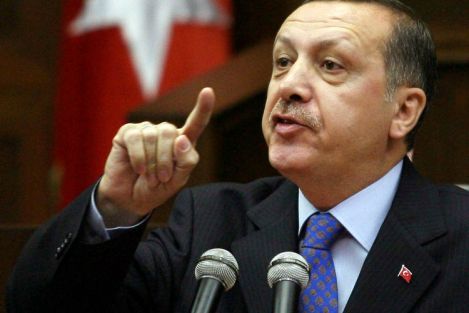
As these words buzz their way across the interweb to you, Turkey's prime minister is at home in Istanbul. He's not running the country; he's recuperating after surgery. It's a relatively routine procedure relating to his digestive system and it's certainly not life-threatening: he'll be back denouncing some rival or another at his party's parliamentary meeting in no time.
In a press release announcing the hospital visit, the office of Recep Tayyip Erdogan (for it is he) sounded almost anxious. The operation went "as planned at the beginning", we are told. "Our Prime Minister's health is absolutely fine. He plans to resume his routine engagements later in the week."
And so he did. He met the son of Bosnia-Herzegovina's founding president, then spoke on the telephone to his British counterpart David Cameron about Syria. Can't say fairer than that, really. Roll on next week's return to parliament.
But as Turkish domestic politics ticked along with routine and not-so-routine developments over the past few months of Mr Erdoğan's hospital treatment, it often fell to other people - such as Deputy Prime Minister Bülent Arınç - to speak for Turkey's government. For the first time in ten years, the talking head for the Turkish government has been not been Mr Erdoğan.
Don't let me mislead you: I'm not saying the prime minister is on his way out. He isn't. He intends to see out tenth year of his job in March 2013, and most likely the eleventh year too. Barring the unforeseen, there's very little that can unseat him until then. His party is riding high in opinion polls and loyalty to him within the party is strong.
But Mr Erdoğan's absence in recuperation might have shown us what the future looks like. Parliament recently decided that Turkey's first popular presidential election will be held in 2014 and Ankara's worst kept secret is that the prime minister wants the job for himself. If he does, he will win. He's more than popular enough to do it.
I first wrote about Mr Erdogan's presidential ambitions in 2006. At the time I said that a candidate for president requires experience, must be known by the public and liked by the public. He had no trouble meeting the last two criteria, I wrote, but as prime minister for a little under four years he did not have that statesmanlike quality - experience in government, knowing how the country runs - that an ideal president needs.
Since I wrote that, Mr Erdogan solidified his public support with victories in two general elections and two referenda. He challenged the Turkish army's influence over the state and won. He established himself as an internationally recognised leader for modern Islam. Whether or not you agree with his politics, the statesmanlike quality is now there.
President Erdoğan would assume his position with just under a year to go before parliamentary elections due by June 2015. The AK Party campaign would be led by a new man. The contenders to be that man are the usual suspects: Mr Arınç; Ahmet Davutoğlu, the foreign minister; Cemil Çiçek, the speaker of parliament; Ali Babacan, another deputy prime minster; or even Abdullah Gül, the current and ostensibly party-neutral president.
The problem is that there is no guarantee that any of these men would inherit the same job Mr Erdoğan vacates. A special parliamentary committee is currently working under Mr Çiçek's leadership to put together a new constitution, a new blueprint for Turkey's institutions which could produce a radical shake-up.
Mr Erdoğan is widely understood to favour a French-style presidential system with himself at the top. That would be a hefty change from the existing arrangement. The role of Turkey's president is notionally ceremonial, but holds considerable indirect influence over the country's institutions. The prime minister, meanwhile, holds more direct executive powers than in many Western democracies; if Mr Erdoğan had his way, a lot of these would simply transfer upward with him.
There is, however, widespread opposition to these plans. Prominent members of Mr Erdoğan's party - including some of those who might contend for his job - have publicly said a presidential system is not desirable to them. Much expends on what the new constitution looks like: little is known so far about the changes, if any, that will be made to the structure of Turkey's executive and legislature.
The new constitution will have to be approved by referendum and may require a renewed parliamentary mandate afterwards. That would mean fresh and early elections, in which Mr Erdoğan would lead his party once more.
The main question over Mr Erdoğan's future is not who will succeed him. It concerns the amount of executive power he thinks he can get away with as president. Watch parliament's constitution committee closely for an answer to that.