We have moved / Taşındık!

If you're reading this, you've come to the old home for the James in Turkey website. The website has changed servers and adopted a new look ahead of the 2014 local election.

For the latest Turkish politics and election analysis from Michael Daventry redirect your bookmarks to jamesinturkey.com.

Friday, 19 January 2007

In a crowded street. On a busy morning.

I was in London when I found out. Having emerged from the cellular blackout of the London Underground, my phone beeped back into life with a voice message. "Call me back as soon as you get this," said an urgent voice. It was my friend in Ankara. "They've shot Hrant Dink. He's dead." I called her back and she told me what little she knew: "It was apparently some boy. Eighteen, maybe nineteen years old. He died instantly."

I had to hang up and continue my tube journey. Frustrated and away from a computer, I sat twiddling my thumbs. I needed to write. So I wrote this, with a pen I found in my pcoket, on the back of the London Underground Customer Charter. It was the only piece of paper I could get my hands on. I had to record my utter disgust and revulsion somewhere. A man was shot today for speaking aloud. It is an incredible tragedy, and I'm desperate that people know that.

Hrant Dink was a journalist. He was a Turkish citizen. His origins, however, were Armenian. He was among the first to be tried under Article 301, that notorious clause in the Turkish penal code that makes it a crime to denigrate "Turkishness". Like Orhan Pamuk, the nobel laureate, Dink too faced trial for his thoughts. Unlike Mr Pamuk, Dink was found guilty. The court gave him a deferred six month prison sentence.

Turkish prime minister Recep Tayyip Erdoğan today said it was significant Dink was targeted. "A bullet has been fired at democracy and freedom of expression," he said. "Our nation, most particuarly our citizens of Armenian origin, have the sense and forethought to overcome this test."

The Nationalist Action Party (MHP) made just a written statement calling for the Turkish people to not be provoked by the incident. "We invite (all) to behave with the utmost responsibility."

I am angry. I am angry because there are people out there who seem to think it is perfectly justified to kill a man who speaks contrary views. I have a perfectly clear idea of who I think is responsible, but there is little use in churning out conspiracy theories now. Suffice to point out that it was in a crowded street, on a busy morning. This was no impulsive killing.

Hrant Dink, journalist. Born September 15th 1954, died January 19th 2007.

Sunday, 14 January 2007

Presidential Election: The Vox Pop

It's funny how these things turn out. Last week, I asked the blogging community at large what they thought about the upcoming Turkish presidential election. Having got a response from a mighty two people - not to discredit IstanbulTory and yuvakuran, thank you both so very much for writing your thoughts - I went and did what any other self-respecting journalist would do: pinch what people have said elsewhere. Here's what I found interesting:

"I don't know who this J. Vincent is," reads one of my favourite (anonymous) comments, "but it's not important. There are many things in life that we don't know anyway - it will do if this isn't known either." Not to worry, I'll be sure to make my introductions over there shortly. The comment goes on: "Does it matter what happens in the election? This country has been ruled by juntaist soldiers, contracted servants, plundering conmen and fascist dogs. What difference will it make for us if the sharia comes in - aren't we still going to be the ones who lose out?"

"The President won't be Tayyip," says IstanbulTory, posting on this blog. "The military/mass media are working to ensure that this doesn't happen." Nor, says he, will it be a consensus candidate such as Hikmet Çetin. "It's more likely to be a fairly obscure AKP member of Parliament whose wife is not veiled. And more importantly someone who will not inflame secular opinion once elected." Defence minister Vecdi Gönül is fielded as a potential compromise - Abdüllatif Şener is another possibility, perhaps?

Yuvakuran focused more on the election aftermath: "(An AKP president) will certainly push the country with all measures, legislations, appointments towards a new environment as moderate Islamic republic in the region. So all secular forces are to defend the existing Western Democratic system to prevail."

It's certainly a bleak outlook. But in all the despair, it seems, there's a victory for academia: "The Middle East Technical University's Alumni Association has created a new working group to review the local Presidential election process in detail." Hooray! "We invite all international interested parties to review the issue and put their intellectual contributions. Also there is practically no application of local penal law if a document is written and released in a foreign language." You'll be hearing from me soon, Yuvakıran.

"Just like parties, the president should also be elected by public vote at the same time with general elections," writes John Gurcam on Yuvakuran's blog. "The president should also be elected for 4 years to work with the party elected for the same period."

The Turkish Daily News also got its finger out last week for a bit of comment: "The presidential elections will be a deciding factor in whether the opposition Republican People's Party (CHP) remains an influential political actor in the general elections." Göksel Bozkurt's piece goes on to outline a number of possible scenarios for the government and opposition. It's well worth a read, although I would question the claim that President Sezer can unilterally scrap a presidential vote and call an early general election.

The wonderful thing about a vox pop is that there's no need for a balanced argument. The above is by no means a cross-section of the presidential debate, although it does raise some interesting points about the course of the next few months. Your comments, as ever, are welcome below. Mine will continue in these pages in the days to come.

Sunday, 7 January 2007

Election 2007: Predictions

The election of a new president in May, and of a government in November, will focus minds. If the parliament, dominated by the Justice and Development Party (AKP) of the prime minister, Recep Tayyip Erdoğan, elects an Islamist as president, secularists will be appalled. Either way, the AKP will win the general election.
  Turkey prediction from "The World in 2007", published by The Economist
Many of the visitors to this blog in the last few months have come having searched "Turkey election 2007", or something similar, in Google. There is little need to question why: the two upcoming elections are events that will eclipse all others in the Turkey of 2007. We can only hope the two votes will indeed focus minds.

Ahmet Necdet Sezer has 99 remaining days in office, and it is still no clearer who his replacement might be. It is unlikely a candidate will emerge until at least February; we may even have to wait until March. This blog has already endorsed Hikmet Çetin as Turkey's next president, but I'm curious to know what the remainder of the blogging community has to say on the matter.

What do you think? Do you agree with a recent Hürriyet interview in which Süleyman Demirel said he expected Mr Erdoğan to become the next president? Do you think I'm right to push for a Hikmet Çetin presidency? Or perhaps, even though it is highly unlikely, would you support an overhaul of Turkey's presidential system that would allow presidents two terms of five years each, thus giving Mr Sezer another three years in power? Such a motion was tabled at the end of Mr Demirel's presidency seven years ago; it failed, and the result was a crossparty compromise in Mr Sezer. Can there be a compromise this time?

The second election of the year is due in 301 days. The Economist is almost dismissive of what will happen in that election ("the AKP will win") but they are right. In a political scene where there is no strong challenger to the governing party, and not enough of a reason to vote them out, why shouldn't they win?

Wednesday, 27 December 2006

Presidential election: It is not Erdoğan's time yet

Deniz Baykal appeared on NTV with something of a threat earlier this afternoon. If the prime minister emerges as a presidential candidate, he said, the CHP will not take part in the vote. His exact words were: "in such a scenario, we will not be standing by as decoration."

The reality of next year's presidential election is that Mr Baykal's party is going to be decoration regardless of who is on the ballot paper. The governing AK party has an overwhelming presence in parliament, just a handful of seats short of the two-thirds majority needed to elect a president in the first two rounds. Even that isn't much of a problem: the rules dictate that if there is no clear winner after the second round, the winning threshold is dropped to a simple majority for the next ballot. That's 276 votes, which the AK party can supply comfortably.

With the mathematics beyond dispute, it really isn't a question of whether the AK party will win, but rather with whom. Prime ministers have certainly become presidents before - look no further than Turgut Özal and Süleyman Demirel - which suggests Recep Tayyip Erdoğan is the most obvious candidate. But it does not necessarily mean he is the right candidate.

Turgut Özal was a remarkable prime minister. He was not a remarkable president. Visibly frustrated by his former party's defeat in the 1991 general election, he never bridged the gap with the victors, the party of longtime rival Süleyman Demirel. Before his untimely death, Özal had a firm vision of what direction Turkey should take forward. It was a vision suited to a prime minister, a man accountable to the general public, but not to a president who serves only as a final check on parliament.

For all his faults - and there are many - Mr Erdoğan too is a competent politician. He has done more to encourage reform, challenge state taboos and raise living standards than any other politician since Özal. But that does not mean he has the indeterminate qualities needed in a head of state. The president is a unifying figure, a statesmanlike individual who embodies all aspects of the country and represents it at home and abroad. Mr Erdoğan is no statesman. Like Özal twenty years before him, he does not have the experience. He has been in national politics for barely half a decade - again, not unlike Özal.

But brushing aside vague ideals of statesmanship, the Turkish constitution offers a far more concrete obstacle in front of Mr Erdoğan's candidacy: impartiality. "Upon election," the constitution reads, "the president must sever all ties with his party." It is one thing to tear up a membership card - like they did with Özal's Anavatan party membership - but actually severing those ties altogether is another matter. At this difficult time in Turkish politics, it will be immensely difficult for Mr Erdoğan to prove he is a Turkish president and not an AK president. And while the electorate might be happy to give him a chance, the state establishment will not.

The Turkish presidency has been ailing for decades. It is the office of a distant figure, disconnected from the public, a man who lives in a high security base in south Ankara and vetoes laws. These were problems less noticeable when the position was occupied by a prominent individual - say, a prime minister or an army chief. But when the post was taken by Ahmet Necdet Sezer, an obscure judge, the presidency was exposed as nothing short of elitist.

The way to change that is to make the president more endearing to the public, by letting the public elect him directly. Despite calls from the opposition, it is unlikely there will be a direct presidential election this time around. Far more likely is for a president to be directly elected in 2014, after Mr Sezer's successor.

In the meantime, someone must be found to become that successor. The candidate must have experience (which rules out Mr Erdoğan for now), he must be known by the public (which, it is hoped, will deter the election of another judge), and he must be liked by the public (which is Mr Baykal's come-uppance). But in these times of political polarisation, the candidate must also not be deeply infused in party politics.

It is time for both parties to nominate - and endorse - Hikmet Çetin to become Turkey's 11th president. Mr Çetin has formerly been foreign minister, deputy prime minister, CHP leader and parliament speaker. He left domestic politics to serve as NATO's highest civilian representative in Afghanistan for two terms, and returned in August of this year. He has never been endearingly close to Mr Erdoğan, but there has not been much love lost with Mr Baykal either.

Hikmet Çetin is a capable, experienced statesman, and the most suitable candidate for Turkey's next president. By nominating Mr Çetin now, Recep Tayyip Erdoğan would not only intercept Mr Baykal's cheap threats of withdrawal, but also establish himself as the man who had the opportunity to rise to the top, and decided to wait. He is not an old man, and 2014 is only seven years away.

Saturday, 16 December 2006

How skipping Antalya could help solve the Cyprus problem

Tony Blair was in Ankara yesterday to offer Britain's support at a time when Recep Tayyip Erdoğan's case for Turkey's EU membership has never looked quite as bleak. The visit came as the EU confirmed eight chapters of Turkey's entry negotiations would be suspended in response to Turkey's staunch refusal to open up to Cyprus. There is little hope of those chapters - or indeed of other unrelated topics, such as Education and culture - being opened anytime soon.

Mr Erdoğan needed a boost in the face of growing EU antagonism at home, and that boost came in the form of a direct acknowledgement from Mr Blair that Britain was looking into - and had therefore not automatically rejected - a Cyprus Turkish Airlines request to fly directly to the UK. Mr Blair said he personally supported the idea, and that they were looking into the legalities of starting direct flights.

As it stands, the only planes flying out of Ercan Airport go to Turkey. There are flights to places such as Britain and Germany, but these legally have to call at a Turkish airport - usually Antalya - before proceeding on to their final destination. Save a few token flights to Azerbaijan, there have been no other flights out of North Cyprus since the trade embargo was first placed in the 1970s.

Tourism is Northern Cyprus's largest source of income - even now, when the only route of entry is via Turkey, it overtakes agriculture. This was the principal reason behind Turkey's insistence on opening more than just a single seaport in the north: it is, after all, far easier to bring the tourists in by air.

If Britain's civil aviation authorities approve the Turkish Cypriot request, it would start the first direct flights between North Cyprus and Europe in decades. It would pre-empt an EU review of Northern Cyprus planned for the end of January, which looks likely to be vetoed by the (Greek) Cypriot government. It would give a much-needed injection of cash at a time when even EU aid is set to be derailed by a southern veto.

But perhaps most importantly of all, it would demonstrate to the EU that the Cypriot issue is not one that can be solved merely by enforcing existing treaties a month before a summit deadline. It would show that a dedicated push - perhaps the efforts of an entire six-month presidency - is needed to solve the Cyprus issue once and for all.

The next rotating president is Germany, whose foreign minister Frank-Walter Steinmeier has promised to personally involve himself in the Cyprus issue. He says he is hopeful the problem can solved by June. His optimism provides little reassurance, but what else can be done but hope?

Sunday, 10 December 2006

Reforming Republican People

Copyright Circassian Canada, 2006Deniz Baykal is an excellent director. He must be. He is a man who can craft, and weld, and manoeuvre. Surely that makes him excellent politician. How else can you explain the 13-year leadership of Turkey's most sacred political party by a man so incredibly disliked?

Deniz Baykal was only the fourth leader of the 69-year-old Republican People's Party (CHP) when he first took the helm in 1992. He resigned twice, first in the wake of an impending merger with the Social Democrat People's Party (SHP) and later after an embarrassing showing in the 1999 elections. But in each case he returned to defeat his successor. It amounts to a cumulative thirteen years as leader.

In the summer of 2002, when hordes of MPs resigned Bülent Ecevit's governing party and triggered yet another crisis in the Turkish left, Mr Baykal saw the opportunity to rebuild his position. He persuaded countless former Ecevitites to switch to the CHP, knocking the wind out of Ismail Cem's attempts to establish a new political force on the left wing. He also scored a big coup in Kemal Derviş, the man credited with resuscitating Turkey after the latest economic crisis, by snatching him away from Mr Cem's clutches.

His tactics worked. When the election came, the country was far too distracted by the prospect of a single party government - and an Islamist one, at that - to notice the CHP's showing. Ataturk's party was back with 178 seats. It was their best result in thirty years.

The result was a personal victory for Mr Baykal, propelling him into a position more influential than when he was deputy prime minister a decade ago. He had become the de facto leader of the secular Turkish left in the face of a resurgent religious threat. He is no longer that leader.

Mr Baykal's failure is partly because he is not an endearing man. He is staggeringly unpopular, especially among secularist Turks who say they vote for him because he is the only viable challenger to the AKP. He is a man driven by his ideology, unable to empathise with the average voter. He is, in fact, a member of that "old guard" of Turkish politics - among the likes of Bülent Ecevit, Mesut Yılmaz and Tansu Çiller - that was purged in the 2002 election. The reason Mr Baykal survived is because he is not as well-known.

But there is more to it than personality. If Mr Baykal's pre-election resurgence was shrewd and calculated, his post-election performance was rash and tactless. He failed to recognise that his party's return to parliament was not from an electorate endorsing his policies, but from part of an electorate worried about an Islamic future. The CHP was not the party of choice, it was the only choice.

Deniz Baykal has done little since to consolidate his party's position. He has not pushed hard enough to unify the Turkish centre-left. He has not made a serious attempt to endear himself to the voting public. He has even lost his badge as leader of Turkey's Kemalists. That title is now shared by Ahmet Necdet Sezer, the president who has vetoed more parliamentary laws than any other in Turkish history, and General Yaşar Büyükanıt, the chief of the army.

The CHP has paid for Mr Baykal's mistakes already. His party performed badly in the 2004 local elections, losing council seats nationwide and barely holding onto traditional strongholds like Ankara's Çankaya district. Mr Baykal, however, refused to accept a defeat, prompting a bemused Radikal headline: "CHP wins victory - apparently".

The downward trend looks set to continue, too. Opinion polls ahead of next November's general election all suggest the far-right Nationalist Action Party (MHP) will return to parliament. But the resurgent nationalist vote, it seems, will not be at the expense of the governing AKP, but of the CHP.

Deniz Baykal has to go, and he has to go soon. But who to come in his place?

There have been mutterings of President Sezer joining active politics. There is, though, a far more sensible replacement in Ismail Cem, who still commands a certain degree of respect in Turkey. He joined the CHP two years ago after his new party experiment failed. When it comes to dismissing Mr Baykal, however, the only solution might be to field him as the compromise successor - to Mr Sezer.

Image © Copyright Circassian Canada, 2006.

Monday, 27 November 2006

Erdoğan to meet Pope (at baggage reclaim?)

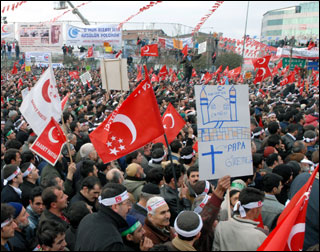
Thousands of people were in Istanbul's Cağlayan neighbourhood today to protest Pope Benedict XVI, who is due in Turkey in Tuesday. There was widespread booing, quite a lot of flag-waving, and many women turned up wearing headscarves and bandanas, clutching bemused babies. It was all organised by the Felicity Party (SP), the successor to the Welfare and Virtue parties that were closed down over the last ten years.

In his frail state, former party leader and prime minister Necmettin Erbakan made an appearance via videolink to say he had no doubt the Pope was coming to resurrect Byzantium in Turkey. Other party officials egged on chants along the lines of "Don't turn the Hagia Sophia back into a church", as current SP leader Recai Kutan spoke out against the European Union.

Security was high at the demonstration, as anyone not carrying SP credentials had their banners confiscated. It did not go unnoticed either that separate protest areas had been allocated for men and women. It was a rather large gathering, with participants from all over the country. It caught the international headlines too - the BBC went with "Turkish protests at Pope's visit" while CNN said 20,000 people attended.

All in all though, it was a rather minor protest from what has become a fringe party. Benedict XVI's visit - a first papal visit to Turkey in many a year - is set to go ahead from Tuesday, and the good news is that he might just meet the sitting prime minister after all. Recep Tayyip Erdoğan had earlier made his excuses for not meeting the Pope, pointing to the schedule clash with a NATO summit in Latvia.

It was slated by domestic commentators as a convenient excuse from a man with a history in political Islam. In its leading article tomorrow, The Times calls it a "snub". But in an eleventh hour rescue, Foreign Minister Abdullah Gül announced the Pope's timetable had shifted forward, and the two are likely to meet at Ankara airport after all. It sends out a positive signal - far from avoiding the Pope, Mr Erdoğan's government has worked to make a meeting, albeit a short one, possible.

"As a government we see the visit as an opportunity," said Mr Gül. "There are many misconceptions about Turkey, but Turkey is a country where tolerance occurs. We hope the visit helps dispel some of the misunderstandings between Muslims and Christians."

The tension that so clearly exists over the upcoming visit has not been helped by Pope Benedict himself, and the lack of forethought over his words for which he becoming notorious. Aside from his controversial Bavarian lecture in September, Benedict XVI managed recently to reiterate his views against Turkey's EU membership, and several Turkish newspapers have him saying at this Sunday's mass that his visit to Istanbul is "another crusade". Ho-hum.

There's a lot hanging on this next week, and the The Times's leading article is absolutely right: to achieve (it all) against a background of rising Muslim suspicion will demand all Benedict's tact, adroitness and humility.

Sunday, 26 November 2006

So they chanted slogans. Who cares?

The following was written on an easyJet flight from Istanbul on Sunday 12th November 2006, the day after Bülent Ecevit's funeral in Ankara. My apologies about the recent break - normal service has been resumed!

Recep Tayyip Erdoğan was visibly annoyed after his party's general conference yesterday, having spent the morning with a hundred thousand people who really don't like him. He was at the funeral of his immediate predecessor, Bülent Ecevit, a man so staunchly secular that when a woman MP dared to enter parliament wearing a headscarf in 1999, television pictures were able to pick up his trademark moustache quivering violently. "Nobody interferes in a woman's choice of dress in her private life," he had thundered from the podium, "but this is no private residence. This is the state's most supreme institution. Please inform this woman of her limits."

Mr Erdoğan, conversely, is everything Mr Ecevit was not, and the funeral crowd knew it. "Turkey is secular, it will remain secular" they chanted all day long, occasionally swapping "Turkey" for "The President" to make a dig at Mr Erdoğan's supposed hopes for the country's top job. It certainly wasn't what he wanted to do with his Saturday morning - his party conference was just a few hours later, after all - but as sitting prime minister it was his duty to go.

When he did finally get to the sports hall hosting his party conference, he found no flag-waving crowds cheering his second unopposed election as leader of the AK party; instead, his audience was subdued and miserable. The entertainers failed to impress, and Mr Erdoğan even had to ask the crowd to cheer up and shout a little more. You could be forgiven for thinking it was all part of the funeral.

Clearly, having conference and funeral on the same day was not a good idea. But Mr Erdoğan wasn't about to shift an already much-delayed party conference, and his efforts to persuade Mrs Ecevit to choose an earlier date proved unsuccessful.

He did respond to the crowd's slogans ("Are you saying that there is someone behaving outside [the bounds of secularism]?") and he did try to set his party's agenda ("We will base our politics on the social centre ground, without repeating history's mistake of swinging to the fringes") but it was really the secularism movement in town that stole the front pages.

Given the massive funeral attendance, it is easy to slate the prime minister's influence, saying the walls are closing in and the AKP is set to lose power in next year's general election. A hundred thousand is a huge figure, yes, but it is tiny next to Turkey's population of 70 million. Not all of the country agrees with yesterday's funeralgoers. It was indeed a bad day for the prime minister, to quote Radikal commentator Murat Yetkin, but it certainly wasn't his end.

As Mr Yetkin wrote just a few days previously, the AKP remains the only one of Turkey's four political ideologies to have broken from its past and embraced the new. Mr Erdoğan and his followers separated from the near-extremist politics of Necmettin Erbakan to create a party that campaigned not on a religious platform but one that understood the electorate. Of the other three ideologies, the centre-left remains bullishly split between Deniz Baykal's CHP, Murat Karayalçın's SHP and Mr Ecevit's former party, the DSP; the centre-right is composed of a True Path Party (DYP) and a Motherland Party (Anavatan) that have spent the last twenty years insisting they are not essentially the same thing; while the extreme right has shown itself to be very good at preaching nationalism, but not so effective in government.

Only the AKP has demonstrated it can put voters before ideology, and the voters have in return made it the largest governing party Turkey has seen since the 1950s. They are likely to do so again next year, if the opinion polls are to be believed.

Yesterday's funeral was not the beginning of the end for Mr Erdoğan; it was the cry of a political class that is out of touch, but has yet to realise it.

Wednesday, 8 November 2006

As the progress report looms...

In a matter of hours, the European Commission will release its latest progress report on Turkey. It seems likely the Commission will criticise Turkey in its strongest language yet, particularly on the matters of Cyprus, Article 301 and human rights. The report will stop short, says NTVMSNBC, of recommending a halt or suspension of membership talks.

The contentious matter of Cypriot access to Turkish ports will be left to a summit of EU leaders to be held in the middle of December. This gives Finland, as term president of the Union, the opportunity to push forward its plans for a solution in Cyprus. They are the likeliest leaders yet to coin a solution - they have, after all, done more to solve the Cyprus issue than anyone since Kofi Annan and his ill-fated plan of 2004.

On the matter of Article 301, it is now too late to change any laws in time for the EU report. But Prime Minister Erdoğan has publicly said a change is necessary, and has called for concrete suggestions on how best to do it.

Foreign Minister Abdullah Gül appeared to be comfortable as he spoke Can Dündar on NTV last night. He said talk of a crisis was simply sensationalism, and pointed to the important steps Turkey had taken thus far.

One interesting point was his insistence that the government was well aware of its responsibilities to the EU. This is a point so easy to overlook: after all, Turkey can hardly be accused of neglecting the EU issue. It is not a Serbia, nor indeed a Croatia. Turkey and Europe are well aware of what each side wants of the other; where they disagree is over whose terms come first.

The focus of Turkey-EU relations now should not be the upcoming progress report, but what will happen after it. There is a month of serious negotiating ahead, and much more than Turkey's EU membership depends on it.

Monday, 6 November 2006

A dove takes flight

Copyright Hürriyet archives, 2006Bülent Ecevit, poet, journalist, and five times prime minister, died last night after a six-month coma. He was 81. Succeeded by his wife, Rahşan Ecevit, and his now greatly diminished Democratic Left Party, he leaves behind perhaps the greatest career in Turkish politics since Atatürk.

His tragedy is that he will be remembered not for his achievements, of which there were many, but for the disasters that occurred during his time in power. In 1974, during his first tensure as prime minster, it was he who ordered the invasion of Cyprus by Turkish troops in response to a Greek-backed coup. He resigned shortly afterwards in an attempt to take his rocketing domestic popularity to an election, but was surprisingly not granted a request to dissolve parliament. Instead, his staunch rival Süleyman Demirel became prime minister. Condemned to oppositon, he was held responsible for the poverty and isolation that struck Turkey as a result of international sanctions.

He returned to office several times after 1977, but was not in office at the time of the 1980 military coup. He was imprisoned and banned from politics all the same, his Republican Left Party (CHP) closed down along with all others. But he continued his political life nonetheless through his wife, launching a new party, the Democratic Left Party (DSP). When his suspension expired, he took the helm himself, refusing calls to merge with a reinvigorated CHP. In the medium term, it turned out to be a shrewd move: while the CHP did quickly return to power in coalition led by Demirel in the early 1990s, it was the DSP who won power in 1999, with Ecevit back in charge after twenty years.

His last term in power was not a happy one. Disaster first struck in August 1999 with a devastating earthquake in northwestern Turkey. Over 20,000 people died in what was considered the country's richest, most properous region. And in 2001, an infamous row with the Turkish president triggered one of the worst economic crises in the country's history. The economy shrank by 10 percent, tens of thousands of jobs were lost, countless more savings rendered worthless. It was a crisis from which he would never recover; his refusal to resign over health grounds in 2002 was simply the last straw.

By dismissing any chance of left-wing unity and campaigning instead as a leader not tainted by corruption, Ecevit did secure his return to power. But his failure to tackle corruption while in power, and his refusal to accept a left coalition even in the wake of an electoral threat from the mildly Islamic Justice and Development Party was to be his downfall. The CHP was returned to parliament as the main opposition; the DSP became little but a fringe party.

But Bülent Ecevit is unjustly associated with shame alone, whereas his achievements were many and will largely go unrecognised. It was he who managed to defy what was in effect the theocracy of Ismet Inönü, toppling Atatürk's ailing right-hand man in a leadership contest in 1973. Despite the disasters that shook his terms in power, he managed to maintain an honest personal image, with his trademark black cap and refusal to be driven around in anything more glamourous than a Renault Safrane. Even President Sezer, the other half of that blistering row in 2001, today praised his politeness. "He was an example," Mr Sezer said, "with his democratic position and intellectual indentity".

Turkey woke up today to newspapers carrying the same picture, that of Ecevit holding a white dove at an election rally. The dove, a universal symbol of purity, was the symbol of his party and the symbol associated with his character. "A dove takes flight" was Hürriyet's headline, Vatan went with the splash "Goodbye, Karaoğlan", using Ecevit's popular nickname.

The head of Radikal's Ankara desk, Murat Yetkin, was on NTV a little while ago, calling him "one of the four or five greatest figures in Turkish history, alongside Atatürk and İnönü and Demirel". There are few who could disagree with that. The legacy may still be in contention, but there's no denying a legend left this world last night.

Bülent Ecevit, former Turkish prime minister. Born May 28 1925, died November 5th 2006.


Image © Copyright Hürriyet archives, 2006.